Jason Hu
All projects
02 / Independent product development

Custom Mechanical Keyboards

I designed, prototyped, manufactured, and delivered custom keyboard systems—from premium machined-aluminum platforms to open-source, 3D-printable enclosures. Customer requirements guided material selection, mounting architecture, internal geometry, and manufacturing methods to tune structural response, acoustics, typing feel, and product quality.

My role
Founder & Product Designer
Timeline / status
2021 — Present
Shipped hardware / ongoing business
Disciplines
Mechanical design · Material experimentation · CNC / FDM · Product development
100+Customers served
$10K+Revenue generated
5,000+People reached through open-source work

Three platforms. Three engineering approaches.

Premium CNC production → human-centered electromechanical design → accessible additive manufacturing

CRYSTAL TKL

A configurable CNC platform, manufactured for customer builds.

I translated customer preferences into a CNC-machined 6061 aluminum case and plate, a brass mass element, and a mounting architecture that tunes the same enclosure for different typing responses.
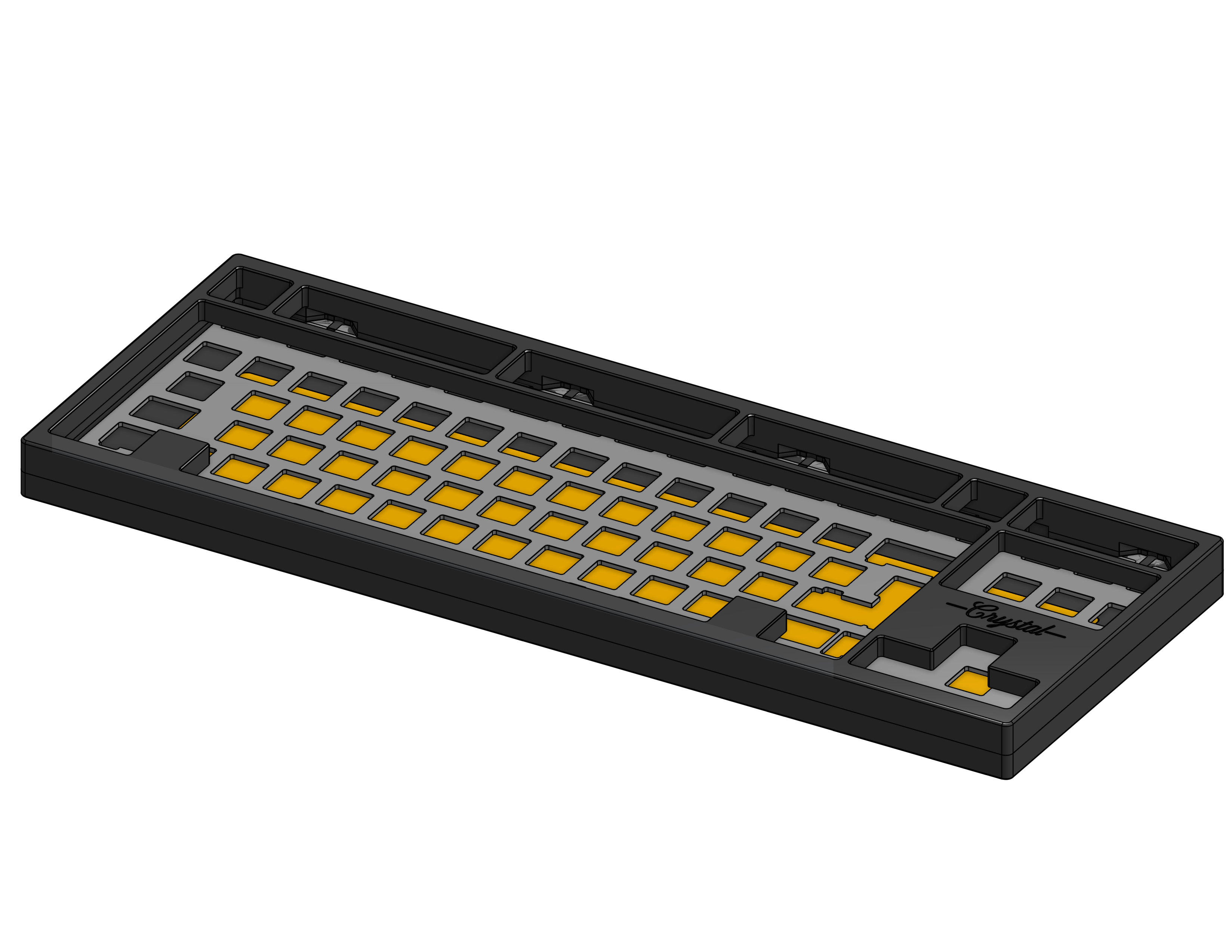
Crystal TKL CAD showing the aluminum chassis, switch plate, and brass mass element.
Enclosure, plate, and mass element packaged as one configurable mechanical system. Open image to inspect details.
Isometric 1 / 3

Four mounts. One chassis.

Top, bottom, gasket, and O-ring configurations change plate boundary conditions, compliance, vibration transmission, damping, and keypress feedback without replacing the enclosure.

Mass informed by users.

Community demand guided the brass weight. Its higher density than aluminum redistributes mass and changes vibration response; geometry and interfaces also shape acoustic character and perceived solidity.

A faceted internal chamber.

Stepped, non-parallel surfaces change reflection paths and cavity response while removing material. PCB and switch clearance, mounting interfaces, wall thickness, fastener access, and CNC tool access remain design constraints.

CAD through production.

I resolved cutter geometry, machining access, fits, fastener interfaces, tolerances, assembly order, and cosmetic finishes through design reviews and vendor communication, then coordinated customer assembly and QC.

DesignConfigurable interfaces + targeted mass + faceted cavity
ResultA customer-built platform with tunable stiffness, feel, and acoustic character.
Hands-on comparative engineering

Material Experimentation

I built and evaluated plates and enclosures across metals, composites, sheet polymers, and FDM materials. Stiffness, density, damping, surface hardness, anisotropy, and process quality all influenced structural response, acoustics, typing feel, durability, and manufacturability.

Control the build

I varied plate and case materials in A/B configurations while holding switches, PCB, mounting configuration, fastener preload, and assembly method consistent; keycaps, geometry, and operating conditions were matched where practical.

Repeat and compare

Repeated assembly and typing evaluations separated persistent material-dependent behavior from build variation. I compared compliance, rebound, local flex, vibration transmission and decay, resonance character, pitch, and acoustic sharpness against mass and interface behavior.

Include production behavior

I assessed surface durability, finish and edge quality, dimensional repeatability, tolerance stability, machining or printing effort, warping, layer anisotropy, and assembly fit alongside cost, scalability, and user feedback.

  1. 01Material selection
  2. 02Controlled build
  3. 03Structural / acoustic evaluation
  4. 04User feedback
  5. 05DFM review
  6. 06Design iteration

Material library

Build observations and selection tradeoffs—not instrumented material-property measurements. Choose a category, then browse the cards.

1–3 of 15 materials

Browse with the arrows, scroll horizontally, or drag / swipe. Comparisons depend on geometry, interfaces, and print settings.

Metals

6061 aluminum

Relative stiffness
High · good specific stiffness
Relative mass
Moderate
Damping / acoustic character
Crisp, relatively bright vs. softer polymers

My observationThe best overall balance I found for premium cases: rigidity, stable fits, finish quality, mass, and machining cost.

Best forPremium machined housings and plates

Manufacturing methodCNC machining · anodizing

Metals

Brass

Relative stiffness
High · lower specific stiffness than aluminum
Relative mass
Very high
Damping / acoustic character
Added mass changes response; a deeper, substantial perceived character

My observationIts mass and visual contrast are most useful where they matter locally; an entire brass enclosure increases weight and cost.

Best forTargeted weights, accents, high-mass plates

Manufacturing methodMachining · slower and costlier than aluminum

Metals

Steel

Relative stiffness
Very high
Relative mass
High
Damping / acoustic character
Rigid plate response with a sharper feel

My observationDurability and low raw-material cost favor rigid plates, but machining effort, mass, and alloy-dependent corrosion need attention.

Best forStrength and rigidity over low mass or compliance

Manufacturing methodSheet cutting / machining · protective finish

Composites

Carbon fiber

Relative stiffness
Very high specific stiffness · directional
Relative mass
Very low
Damping / acoustic character
Layup and fiber direction shape plate response

My observationLightweight stiffness is compelling, but orientation and layup make it unsuitable to treat as an isotropic metal substitute.

Best forLightweight plates with controlled fiber orientation

Manufacturing methodComposite sheet cutting · abrasive tooling and dust control

Composites

FR4 fiberglass

Relative stiffness
Moderate
Relative mass
Low–moderate
Damping / acoustic character
More forgiving compliance than metal plates

My observationStable, inexpensive sheet stock gives a useful compliance/cost balance; edge quality and abrasive machining still matter.

Best forValue-oriented, forgiving keyboard plates

Manufacturing methodGlass-epoxy sheet cutting · dust and tool-wear control

Polymers

POM / Delrin

Relative stiffness
Low relative to metals
Relative mass
Low
Damping / acoustic character
Compliant, softer and more muted

My observationToughness and compliance support softer plate behavior, while thermal expansion and creep require care at loaded interfaces.

Best forCompliant plates and isolation components

Manufacturing methodSheet machining · low-friction engineering polymer

Polymers

Polycarbonate sheet

Relative stiffness
Low relative to metals
Relative mass
Low
Damping / acoustic character
Flexible, less sharp plate character

My observationImpact toughness and translucency suit flexible, visually distinctive parts; machining attention and scratch resistance limit finish choices.

Best forFlexible plates and translucent components

Manufacturing methodSheet cutting / machining

3D printed

PLA

Relative stiffness
High among common unfilled FDM polymers
Relative mass
Low
Damping / acoustic character
Stiff printed baseline · geometry-dependent

My observationEasy printing and accurate geometry made PLA my accessible prototyping baseline; brittleness and low heat resistance limit duty.

Best forFit checks and accessible prototypes

Manufacturing methodDesktop FDM · low warp

3D printed

PLA+

Relative stiffness
Formulation-dependent · typically fairly stiff
Relative mass
Low
Damping / acoustic character
Printed response depends on formulation and structure

My observationImproved toughness can extend PLA’s usefulness without losing printability, but supplier formulations require comparison.

Best forFunctional prototypes with simple printing

Manufacturing methodDesktop FDM · generally easy to print

3D printed

PETG

Relative stiffness
Moderate · less crisp than PLA
Relative mass
Low
Damping / acoustic character
More ductile, less rigid printed response

My observationToughness, layer adhesion, and improved heat tolerance favor durable functional cases; stringing can compromise interface finish.

Best forAccessible functional printed enclosures

Manufacturing methodDesktop FDM · manage stringing and edges

3D printed

ABS

Relative stiffness
Moderate · lower than PLA
Relative mass
Low
Damping / acoustic character
Tough, impact-tolerant and more damped

My observationHeat resistance and impact behavior improve functional duty, but warp and shrinkage make dimensional repeatability harder.

Best forFunctional cases with controlled printing

Manufacturing methodFDM · controlled enclosure and warping management

3D printed

ASA

Relative stiffness
Moderate · similar to ABS
Relative mass
Low
Damping / acoustic character
Tough printed response · geometry-dependent

My observationUV and heat resistance extend functional durability; controlled printing remains necessary for reliable fits and finish.

Best forDurable printed cases exposed to heat or sunlight

Manufacturing methodEnclosed FDM · manage shrinkage and warp

3D printed

Nylon / PA

Relative stiffness
Compliant · grade and moisture dependent
Relative mass
Low
Damping / acoustic character
Tough, resilient and fatigue-tolerant

My observationUseful for resilient interfaces, but absorbed moisture changes dimensions and printing behavior, complicating stable tolerances.

Best forClips, flexible interfaces, durable functional parts

Manufacturing methodFDM · dry material and control print conditions

3D printed

TPU

Relative stiffness
Very low · elastic
Relative mass
Low
Damping / acoustic character
Highly compliant, damped interface behavior

My observationElasticity helps isolate contact points and tune mounts; it does not provide the rigidity needed for the primary chassis.

Best forGaskets, feet, bumpers, compliant mounts

Manufacturing methodFlexible-filament FDM

3D printed

Polycarbonate filament

Relative stiffness
Moderate–high among tough FDM polymers
Relative mass
Low
Damping / acoustic character
Tough structural response · print-dependent

My observationHeat resistance and toughness suit demanding parts, but equipment requirements and warping reduce accessibility.

Best forHigh-performance printed parts with suitable equipment

Manufacturing methodHigh-temperature FDM · hot chamber and warp control

System-level selection

Engineering the response

No material is universally best. Plate stiffness, enclosure mass, damping, mounting constraints, cavity geometry, and interface behavior interact; I selected materials for the intended product response and production process.

Design intentMaterial direction
Premium enclosure6061 aluminum
Targeted mass / visual accentBrass
High stiffness at low massCarbon fiber
Compliant platePOM · polycarbonate sheet · FR4
Accessible printed casePLA · PETG
Durable engineering partsNylon / PA
Compliant interfaceTPU
Full product ownership

From CAD to product

  1. 01User requirements
  2. 02Concept
  3. 03CAD packaging
  4. 04Material selection
  5. 05DFM & tolerancing
  6. 06Manufacture
  7. 07Assembly & QC
  8. 08User feedback
  9. 09Iteration

I owned consultation and requirements gathering, custom CAD, component sourcing, outside-vendor manufacturing coordination, assembly, and quality control. Design reviews and user feedback connected machining and print constraints to the behavior of delivered hardware.

Across the business, I served 100+ customers and generated $10K+ in revenue. Published open-source hardware designs and build documentation reached 5,000+ people, extending the work into repair, modification, and community iteration.

NEXT CASE STUDY / 03

Turning ambiguous client needs into testable mechanical requirements.

View project